

01 / Receive
Know what came in.
Capture incoming lots, quantities, and receiving checks where the work happens.
Food production, on the same page
Give your team one place to find the work, record what happened, and leave a clear handoff. From the first delivery to the finished lot.
Production floor software. Made for the people doing the work.
The work comes first
Capture incoming lots, quantities, and receiving checks where the work happens.
Work from the production queue with recipe, ingredient, and output context together.
Enter readings against configured checks. Keep adverse results and pending reviews visible.
Record outgoing movement with the lot history your team needs to follow the work.
One floor. A connected record.
Operators need a clear next step. Quality and operations teams need a record they can follow. ActaPath keeps both close to the work.
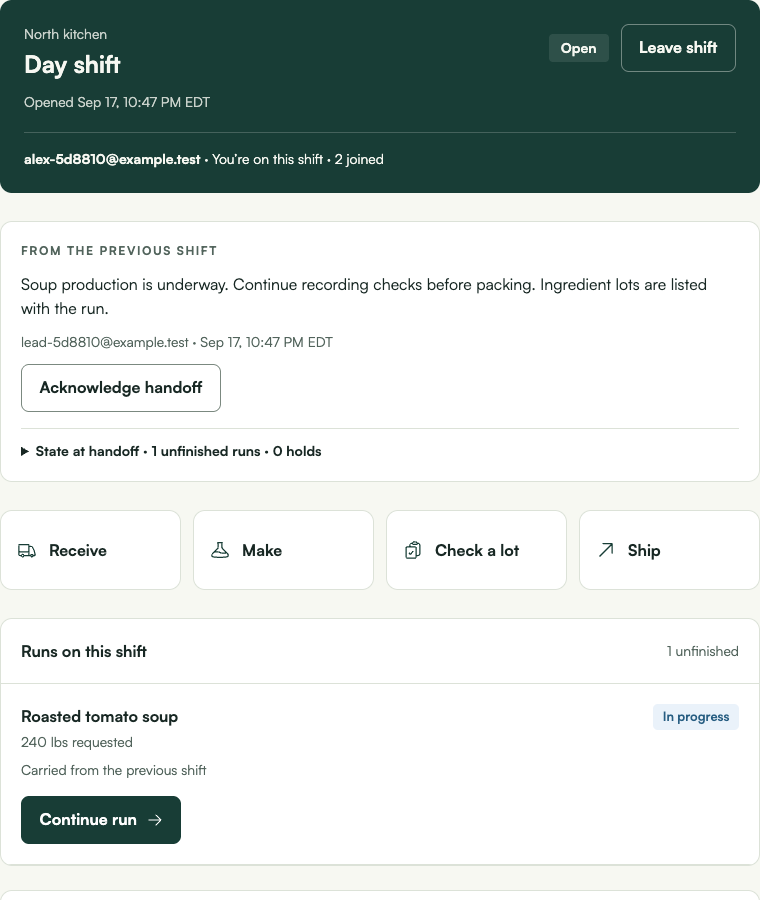
Join the facility shift, see the runs, and record contributions as yourself. Leave a handoff the next team can acknowledge.
Keep recorded work, quality review, and lot release distinct. See what is saved and what still needs attention.
Trace lot relationships, review amendments, and export records without rebuilding the story from scattered notes.
A few practical details
Food production teams, including co-packers, growers, and packing operations that need to connect everyday work with quality and lot records.
A lead opens a shift for a facility. Operators join it, work from associated production runs, and record their contributions. A saved handoff carries unfinished work to the next team.
Yes. Receiving, production, harvest, packing, cooling, and shipping forms remain available. Shift context is explicit when you choose to use it.
ActaPath helps your team capture and review records. Your operation still defines its processes, check requirements, and review and release responsibilities.
Request early access below. Tell us a little about your operation so we can discuss fit and next steps.
Let’s talk about your floor
Request early access to ActaPath. We’ll follow up to learn about your team and the work you want to make easier.
We can't find the internet
Attempting to reconnect
Something went wrong!
Attempting to reconnect