
Built for growers
You already know
your operation.
Let's make it visible.
FSMA 204 traceability starts at the farm — and that's where ActaPath starts too. Log a harvest from your phone. Assign a lot code before the box closes. Share that record with your buyer automatically. No office. No desktop. No extra steps.
What growers are dealing with
If your operation handles foods on the FDA's Food Traceability List, these aren't edge cases.
Your traceability records live wherever you could find paper.
Field harvest logs, cooling tickets, packing slips — scattered across clipboards, shared drives, and notebooks. FSMA 204 requires specific data elements at every tracking event, in a format producible on short notice. Paper-to-electronic conversion under pressure is where small farms are most exposed.
Your buyer needs a lot code you haven't assigned yet.
FSMA 204 requires Traceability Lot Codes to be assigned at initial packing and passed through every subsequent step. When that lot code is missing or inconsistent, your co-packer can't fill it in retroactively — and their compliance gap points back to you.
Your buyers are starting to ask. Your system isn't ready to answer.
Major retailers are requiring enhanced traceability from suppliers — some exceeding FSMA 204 requirements. FDA enforcement begins July 2028. The question isn't if you'll need a working system, it's whether you build it now or scramble later.
Enterprise compliance tools cost more than your monthly operating margin.
The traceability platforms built for large food manufacturers start at $20,000+ per year. They weren't designed for a 15-acre farm or a two-person operation. ActaPath was. The rule applies to your products, not your size — but meeting it shouldn't require an enterprise budget.
How ActaPath works for growers
Three events. All the required data. Nothing extra.
Log the harvest
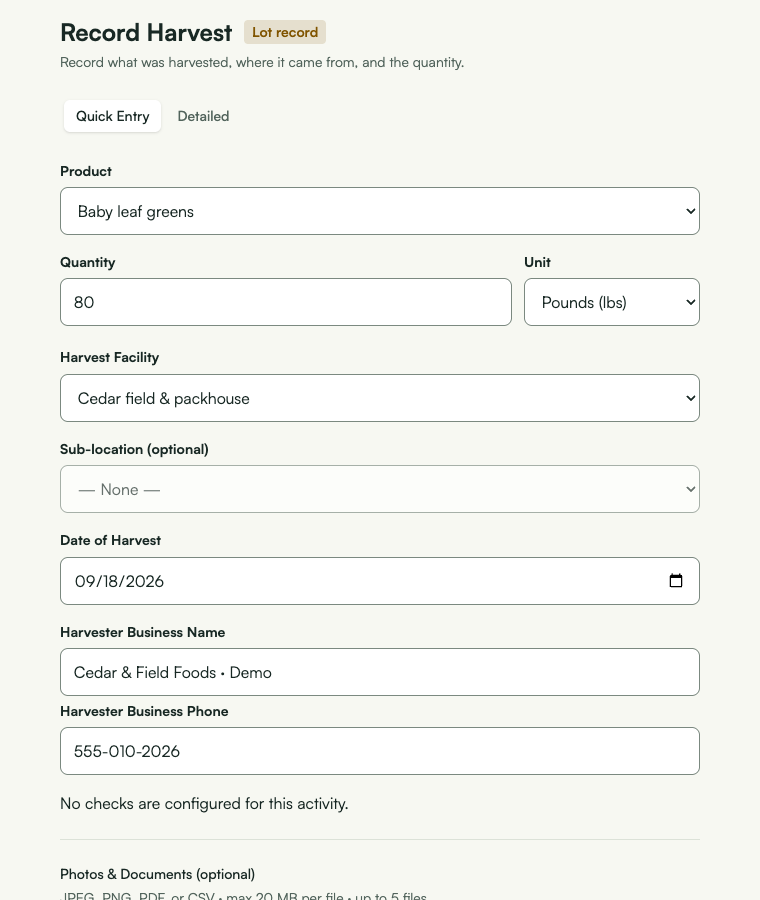
From your phone, in the field. Record harvest date, location, crew, quantity, and commodity. ActaPath generates a lot code on the spot and stores the record.
Required FSMA 204 data captured:
Harvest date · Location · Quantity · Variety · Traceability Lot Code (assigned here)
Record cooling and initial pack
If the lot goes through cooling or initial packing, log it. The lot code you assigned at harvest carries forward. No re-entry. The chain stays intact from the first event.
Required FSMA 204 data captured:
Cooling facility · Time in / out · Initial pack date · Lot code propagation
Ship — your buyer already has the data
When you log a shipment to a co-packer or distributor on ActaPath, your records flow to their receiving log automatically. No email. No spreadsheet attachment. No broken handoff.
Required FSMA 204 data captured:
Ship date · Quantity · Recipient · Lot code · TLC source information
Compliant records from the field, not the office.
ActaPath is designed for phones. Log events while the lot is still in front of you — not reconstructed from memory at end of day.
Your buyers get your data automatically.
Invite your co-packer or distributor to ActaPath and your lot records flow to them when you ship. You both stay compliant without duplicate work.
When the FDA calls, you have 24-hour response covered.
Every lot you've logged is in one place, already in a sortable format. The records request that would have taken days takes minutes.
No IT team. No consultant. No six-month onboarding.
Set up in a day. Log your first harvest the same afternoon. ActaPath is purpose-built for operations where the owner is also the compliance officer.
Mobile-first logging
Log events from your phone in the field — no office computer required.
Automatic lot code generation
TLCs assigned at harvest — no manual numbering, no duplicate codes.
Direct data sharing with buyers
Your records flow to your co-packer or distributor when you ship — no emails, no attachments.
Priced for small operations
Not $20,000/year. Not an ERP. Built for 1–20 person farms with real operational costs.
Before you read further
Not every farm is covered — and we'll help you figure out where you stand.
FSMA 204 (21 CFR Part 1, Subpart S) applies to farms that grow, pack, or hold foods on the FDA Food Traceability List. Small farms with average annual FTL food sales under $250,000 over the prior 3 years may qualify for an exemption from the enhanced Subpart S requirements — though they must still maintain basic "one up, one back" records. Even if you're exempt today, many buyers are requiring traceability independent of FDA enforcement. If you're not sure, reach out — we can help you check before you commit to anything.
Also on ActaPath
Do you also pack for others, or sell to a co-packer?
See how ActaPath handles transformation events, multi-client records, and PCQI workflows.